Custom Pokémon Card Printing: Sizes, Card Stock and Holo Finishes
A practical guide to printing custom Pokémon cards: the exact card size in millimeters, inches and pixels, which card stock to choose, how holographic finishes work, and how to order.
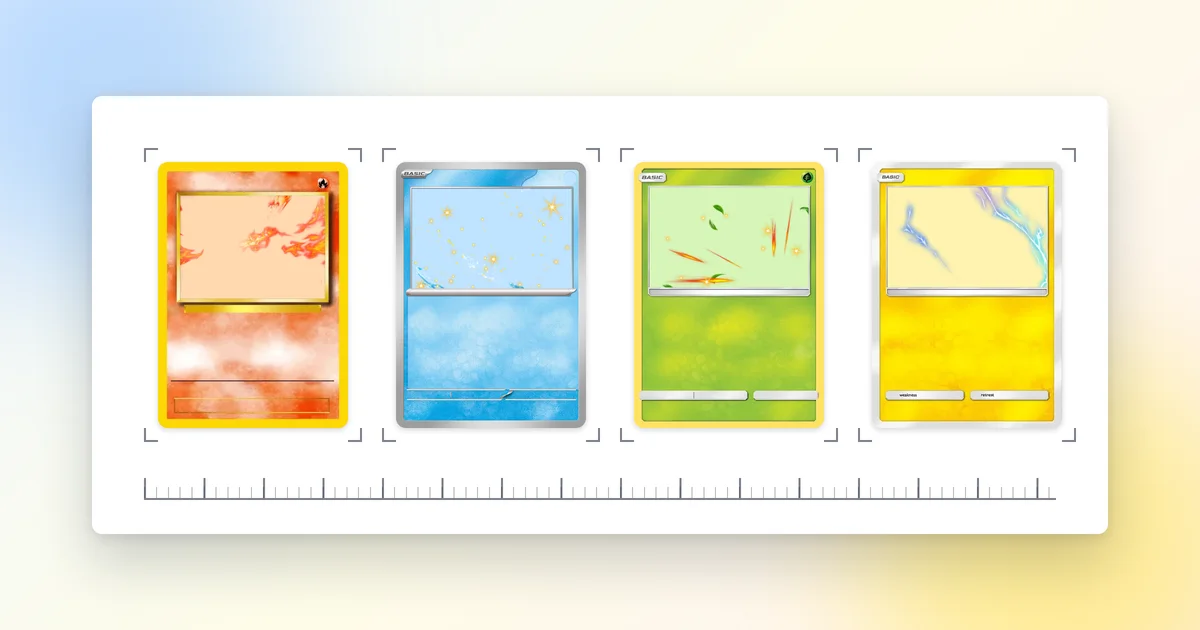
A card on a screen is fun. A card in your hand is better. Printing a custom Pokémon card well comes down to a few numbers: the right size, enough resolution, suitable card stock and a little margin for the cutter. This guide covers all of them, whether you plan to print at home or order a professionally printed card.
Pokémon card size at a glance
| Measurement | Value |
|---|---|
| Size in millimeters | 63 × 88 mm |
| Size in inches | About 2.5 × 3.5 in |
| Size in pixels at 300 DPI | 750 × 1050 px |
| With bleed for cutting | 825 × 1125 px (an extra 1/8 in on every side) |
| Corner radius | About 3 mm |
| Thickness | About 0.3 mm |
Pokémon cards share the standard trading card size, the same one used by most card sleeves, binders and top loaders. The corner radius and thickness are approximate, because no official specification is published for them.
Cards downloaded from the CreatePokeCard editor are 750 × 1050 pixels, which is the full card at 300 DPI.
Resolution: why 300 DPI matters
DPI means dots per inch. Print needs far more detail than a screen does, and 300 DPI is the usual minimum for sharp text on a card. At that resolution a 2.5 × 3.5 inch card needs 750 × 1050 pixels.
Two things follow from this:
- Start with large artwork. A small picture stretched to fit the card will print soft, however good it looks on a phone.
- Print at actual size. In the print dialog choose 100% scale, not "fit to page". A card that is scaled to fill a sheet of paper will not fit a sleeve.
Bleed and safe zone
Cutting machines are not perfectly precise. Printers allow for that with two margins:
- Bleed is extra artwork that extends past the cut line, usually 1/8 inch (about 3 mm) on each side. If the cut drifts slightly, the edge still shows color instead of a white sliver.
- The safe zone is the area a further 1/8 inch inside the cut line. Keep names, numbers and other important details within it so nothing is trimmed.
Card templates already keep their text well inside the safe zone. If you prepare a file for another printer yourself, extend the background outward to create the bleed. Do not enlarge the whole card to do it.
Choosing card stock
The paper makes the difference between a card that feels real and one that feels like a flyer.
- Weight. Trading cards are typically printed on stock of around 300 to 330 gsm (grams per square meter). Ordinary office paper is about 80 gsm.
- Core. Quality card stock is made of two layers of paper with a dark core between them. Hold a cheap card up to a lamp and light shines through. A cored card stays opaque.
- Blue core and black core. Both block light. Black core is the more opaque of the two and is generally considered the premium option.
- Finish. A smooth, lightly coated surface shows color well and resists fingerprints.
Holographic finishes
A holographic card has a reflective layer that shifts color as the card tilts. There are two ways to get the effect:
- A holographic print. The card is produced on holographic stock, so the shine is part of the card. This is the durable, professional result.
- A home-made overlay. Hobbyists print the design on transparent film and place it over holographic card or vinyl. It takes patience, and the result varies with the materials.
Holographic finishes look best when the artwork has open areas of lighter color for the shine to show through. A very dark picture hides most of the effect.
Do not confuse a printed holographic finish with the visual effects in the editor. Effects such as sparkles and rainbow shimmer are part of the image itself, so they appear on a downloaded card and on a standard print as well.
Printing custom cards at home
Home printing is fine for a quick gift or for testing a design.
- Download your card as a PNG.
- Place it in a document at 63 × 88 mm, or 2.5 × 3.5 inches. Nine cards fit on one Letter or A4 sheet.
- Print at 100% scale using the printer's best quality setting, on the heaviest card or photo paper it accepts.
- Cut along the edge with a craft knife and a metal ruler, or a paper trimmer.
- Round the corners with a corner punch of about 3 mm.
Most home printers cannot feed true 300 gsm card stock, so home-made cards are thinner than real ones. A common fix is to put the print in a card sleeve in front of an ordinary card, which gives it the right stiffness.
Ordering professionally printed cards
For a card that feels like the real thing, order a print. From the editor:
- Finish your design and press Add to Cart.
- Choose the card type: a standard playing card or a holographic card.
- Optionally add a custom back by uploading your own image for the reverse side.
- Set the quantity and check out. You do not need an account to place an order.
Every card is printed to order. Production takes 2 to 5 business days, and cards ship worldwide in a rigid protector inside a padded mailer. Current prices are shown in the cart before you pay, and delivery estimates for each region are listed on our Shipping & Returns page.
Pre-print checklist
- The name, attacks and flavor text are spelled correctly.
- The artwork is sharp when you zoom in to 100%.
- Nothing important sits right at the edge of the card.
- The card's type and colors match the artwork.
- For a holographic print, the art has some lighter areas.
- You have the right to use the picture, especially if it shows another person.
What printed custom cards are for
Printed custom cards make good gifts, party favors, keepsakes and display pieces, and they work for casual games with friends. They are fan-made items, not official Pokémon products. Official Play! Pokémon tournaments allow only genuine Pokémon Trading Card Game cards, and custom cards should never be sold or passed off as real ones.
Not designed your card yet? Follow our step-by-step guide to making a custom Pokémon card, or use the AI art guide to create the artwork first.
Frequently asked questions
What size is a Pokémon card in mm, inches and pixels?
A standard Pokémon card measures 63 × 88 mm, which is about 2.5 × 3.5 inches. At 300 DPI, the usual print resolution, that is 750 × 1050 pixels.
What paper are trading cards printed on?
Trading cards are printed on layered card stock, typically around 300 to 330 gsm, with a blue or black core in the middle. The core layer stops light passing through the card and gives it its stiffness and snap.
Can you print your own Pokémon cards at home?
Yes, for casual use. Print at actual size (100% scale) on heavy card or photo paper, cut along the edge and round the corners. Home prints will be thinner than real cards, so many people slip them into a card sleeve in front of an ordinary card.
How do you make custom holographic Pokémon cards?
The reliable way is to order a holographic print, where the card is produced on holographic stock. At home, the usual method is to print the design on transparent film and lay it over holographic card. You can order a holographic copy of any design from the card maker.
How long does a printed card take to arrive?
Cards are printed to order, which takes 2 to 5 business days, and are then shipped worldwide. Delivery to the United States typically takes 10 to 18 business days after dispatch. See Shipping & Returns for other regions.
Can I use printed custom cards in tournaments?
No. Official Play! Pokémon tournaments allow only genuine Pokémon Trading Card Game cards. Custom cards are for gifts, display and casual games with friends.
Is it legal to sell custom Pokémon cards?
Custom cards are fan-made items for personal, noncommercial use. Pokémon names, characters and designs belong to their owners, so custom cards should not be sold or presented as official products.